Look around you right now.
Your desk, your water bottle, the air you are breathing, even your own hands. All of it is matter.
Matter is everywhere. It makes up everything you can touch, taste, or smell. Scientists have spent thousands of years trying to understand it. And the good news? Once you understand the basics, matter is not hard at all.
This guide explains what matter is, how it works, and why it matters (yes, the pun is intended). By the time you finish reading, you will know more about matter than most adults.
What Is Matter? (The Simple Answer)
Matter is anything that has mass and takes up space.
That is the whole definition. Two things: mass and space.
- Mass means it has weight. You can put it on a scale.
- Takes up space means it has volume. It fills a spot in the world.
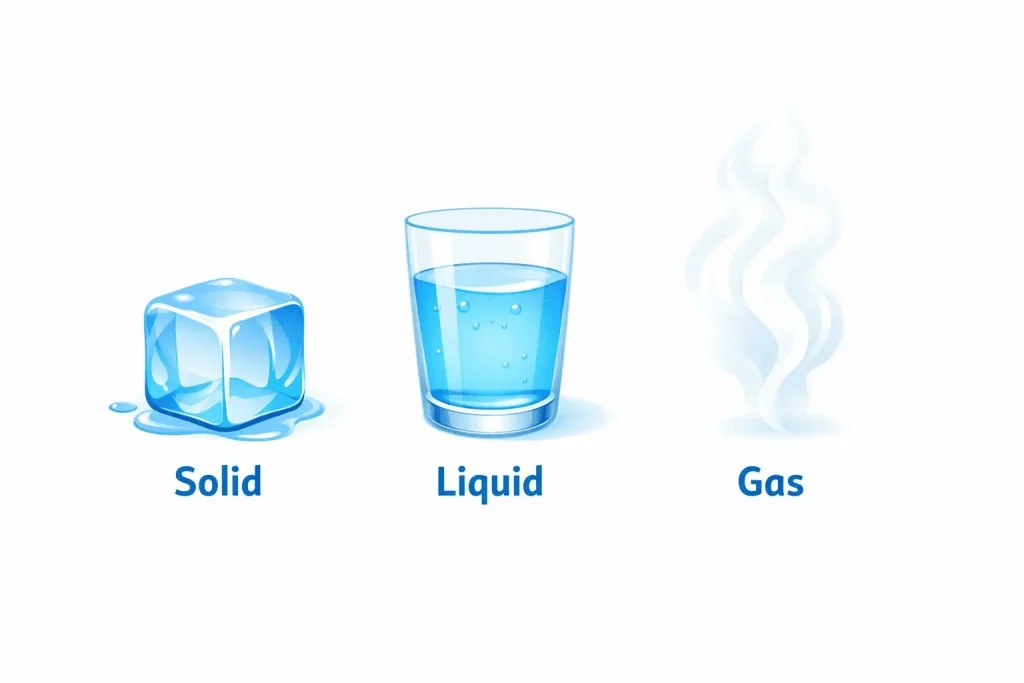
Your pencil has mass. Your pencil takes up space. So your pencil is matter. Water has mass. Water takes up space. Water is matter.
Even the air around you has mass and takes up space. So air is matter too, even though you cannot see it.
What Is NOT Matter?
Not everything is matter. This part trips people up.
Light is not matter. You cannot put light on a scale. It has no mass.
Sound is not matter. Heat is not matter. Emotions, thoughts, dreams? Not matter.
These are all forms of energy. Energy is real, but it is different from matter.
So the rule is simple: if it has mass and takes up space, it is matter. If it does not, it is energy.
What Is Matter Made Of?
Everything you see is made of tiny building blocks called atoms.
Atoms are so small that millions of them fit on the period at the end of this sentence.
Every single piece of matter in the universe is made of atoms. Your body has about 7 billion billion billion atoms in it. (That is not a typo. That number is real.)
Inside an Atom
Each atom has three parts:
Protons sit in the center of the atom. They carry a positive charge.
Neutrons also sit in the center. They carry no charge at all.
Electrons fly around the outside in a cloud. They carry a negative charge.
The center part (protons + neutrons together) is called the nucleus.
Think of it this way: the nucleus is like the sun, and the electrons are like planets orbiting around it. That is not a perfect picture, but it helps you see the idea.
Atoms Make Molecules
Sometimes atoms join together to form molecules.
Water is a great example. Two hydrogen atoms join with one oxygen atom to make one water molecule. Scientists write this as H₂O.
Oxygen in the air around you comes in pairs. Two oxygen atoms connect to make one oxygen molecule (O₂).
When molecules of the same type group together, they form a substance. Water is a substance. Gold is a substance. Salt is a substance.
Learn in details Physics Fundamentals.
The 4 States of Matter
Here is where things get really interesting.
Matter does not always look or act the same way. The same stuff can exist in different forms depending on temperature and pressure. Scientists call these forms states of matter.
There are four main states. You already know three of them from everyday life.
1. Solid
A solid keeps its shape on its own. You do not need a container to hold it.
In a solid, atoms and molecules pack together very tightly. They do not move around much. They just vibrate in place, like someone standing still and shaking.
Examples of solids:
- Ice
- A rock
- A wooden table
- Your bones
Ice is a great example to keep in mind. It is water in solid form. It holds its shape. If you put a ice cube on the counter, it stays a cube (at least for a little while).
Key facts about solids:
- Fixed shape (keeps its own shape)
- Fixed volume (stays the same size)
- Particles are packed tightly together
2. Liquid
A liquid does not hold its own shape. It takes the shape of whatever container you pour it into.
In a liquid, atoms and molecules stay close together, but they can slide past each other. Think of people in a crowd who are packed in but still shuffling around.
Examples of liquids:
- Water
- Orange juice
- Honey
- Mercury (the liquid metal inside old thermometers)
Pour water into a round glass, and it becomes round at the bottom. Pour it into a square container, and it becomes square. The water itself does not change. Only its shape changes.
Key facts about liquids:
- No fixed shape (takes the shape of its container)
- Fixed volume (same amount of liquid no matter the container)
- Particles are close but can move
3. Gas
A gas spreads out to fill whatever space it is in. It has no fixed shape and no fixed volume.
In a gas, atoms and molecules fly around fast and far apart. They bounce off each other and off the walls of their container. If you open a container of gas, it spreads out into the room.
Examples of gases:
- Air (a mix of gases)
- Steam (water in gas form)
- Helium (the gas that makes balloons float)
- Carbon dioxide (what you breathe out)
Blow air into a balloon. The air expands to fill the whole balloon. Let the air out, and it spreads through the room. That is what gases do.
Key facts about gases:
- No fixed shape
- No fixed volume
- Particles move fast and are far apart
4. Plasma
Plasma is the fourth state of matter, and most people do not learn about it until later in school. But it is worth knowing about now because plasma is actually the most common state of matter in the whole universe.
Plasma is like a super-hot gas. When you heat a gas to a very high temperature, the electrons break free from their atoms. What you get is a mix of free electrons and charged particles zooming around together. That is plasma.
Examples of plasma:
- The sun (the sun is made almost entirely of plasma)
- Lightning bolts
- The northern lights (aurora borealis)
- Neon signs
- The inside of a TV plasma screen
You see plasma more often than you think. Every time you see a lightning bolt crack across the sky, you are looking at plasma.
Key facts about plasma:
- Like a gas, but super-energized
- Made of free electrons and charged particles
- The most common state of matter in the universe
Week in physics? Learn it from basic with Physics Starter.
How Does Matter Change States?
Here is one of the coolest things about matter: the same stuff can change from one state to another.
Water is the best example. Water can be solid (ice), liquid (water), or gas (steam). It is always water. It always has two hydrogen atoms and one oxygen atom. But its state changes depending on temperature.
Add heat, and matter moves up the states:
- Solid turns to liquid. We call this melting.
- Liquid turns to gas. We call this evaporation or boiling.
- Gas can even become plasma if you add enough energy.
Remove heat, and matter moves back down:
- Gas turns to liquid. We call this condensation.
- Liquid turns to solid. We call this freezing.
There is even a special change where solid skips liquid completely and turns straight into gas. This is called sublimation. Dry ice (frozen carbon dioxide) does this. It goes from solid straight to gas without ever becoming a liquid puddle. Pretty cool.
Why Does Heat Change the State of Matter?
Heat is energy. When you add heat to a substance, you give its particles more energy. Those particles start moving faster.
In a solid, the particles were barely moving. Add heat, and they start to shake faster and faster until they break free from their fixed positions. The solid melts into a liquid.
Add more heat to the liquid, and the particles move so fast they fly away from each other completely. The liquid becomes a gas.
Take heat away, and the opposite happens. Particles slow down and get closer together.
Matter vs. Mass vs. Weight
People mix these three words up all the time. Here is the difference.
Matter is the stuff itself. The atoms and molecules.
Mass is how much matter is in an object. You measure mass in grams or kilograms.
Weight is how hard gravity pulls on that mass. You measure weight in pounds or newtons.
Here is a fun way to see the difference:
If you took a basketball to the moon, its mass would stay the same. It still has the same amount of matter. But its weight would be much less, because the moon has weaker gravity.
Your mass stays the same wherever you go. Your weight changes depending on where you are.
Examples of Matter in Everyday Life
Matter is everywhere. Here are some examples organized by state:
Solid matter you see every day: Your phone, your clothes, your shoes, a sandwich, a chair, a book.
Liquid matter you use every day: Water in your cup, milk, shampoo, rainwater, blood in your body.
Gas matter around you right now: The oxygen you breathe, the carbon dioxide you breathe out, steam from hot food, the air inside a car tire.
Plasma in the world around you: The sun in the sky, lightning during a storm, the glow inside a neon sign.
What Is Dark Matter?
Scientists have discovered something strange about the universe.
When they look at galaxies (giant groups of stars), the galaxies spin faster than they should. Based on the matter we can see, there is not enough gravity to make them spin that fast.
This means there must be extra matter somewhere that we cannot see. Scientists call it dark matter.
Dark matter does not reflect light. We cannot touch it or detect it with normal tools. But scientists can see its effects on other things, like the way it bends light passing nearby.
Nobody knows exactly what dark matter is made of yet. It is one of the biggest mysteries in science today. Scientists estimate that about 27% of the universe is dark matter. Only about 5% is the regular matter we see and study every day.
That means almost everything you have learned in this guide covers just 5% of the matter in the universe. Science still has a long way to go.
Quick Review: What Did You Learn?
Here are the key ideas to remember:
What is matter? Anything with mass that takes up space.
What is matter made of? Atoms, which contain protons, neutrons, and electrons.
What are the 4 states of matter? Solid, liquid, gas, and plasma.
How do states change? Adding heat makes matter move from solid to liquid to gas. Removing heat reverses the process.
What is mass? The amount of matter in an object.
What is plasma? A super-hot, energized state of matter. The most common state in the universe.
Frequently Asked Questions About Matter
Is air matter?
Yes. Air has mass and takes up space. You can feel it when the wind blows. You can compress it inside a tire. Air is matter, even though you cannot see it.
Is light matter?
No. Light does not have mass. It does not take up space. Light is a form of energy, not matter.
What is the most common state of matter in the universe?
Plasma is the most common state of matter in the universe. Stars, including our sun, are made of plasma. Most of the visible universe is in a plasma state.
Can matter be created or destroyed?
No. This is one of the most important laws of science. We call it the law of conservation of mass. Matter can change forms. It can change states. It can become energy (as Einstein showed with E = mc²). But the total amount stays the same.
What is the smallest piece of matter?
For everyday science, atoms are the smallest units of matter that keep the identity of a substance. But inside atoms, there are even smaller particles called quarks and leptons. These are the smallest known building blocks of matter.
Why does ice float on water?
Most liquids are heavier than their solid forms. But water is special. When water freezes, its molecules form a crystal structure that takes up more space. This makes ice less dense than liquid water. Less dense things float. That is why ice cubes float in your drink instead of sinking.
Summary
Matter is the physical stuff that makes up our world. It has mass and takes up space. Everything you can touch, taste, or smell is matter.
Matter is made of atoms. Atoms contain protons, neutrons, and electrons.
Matter comes in four states: solid, liquid, gas, and plasma. Each state depends on how much energy the particles have. Heat changes matter from one state to another.
The universe is full of matter in all its forms. From the ice in your freezer to the sun in the sky, matter is all around you, all the time.