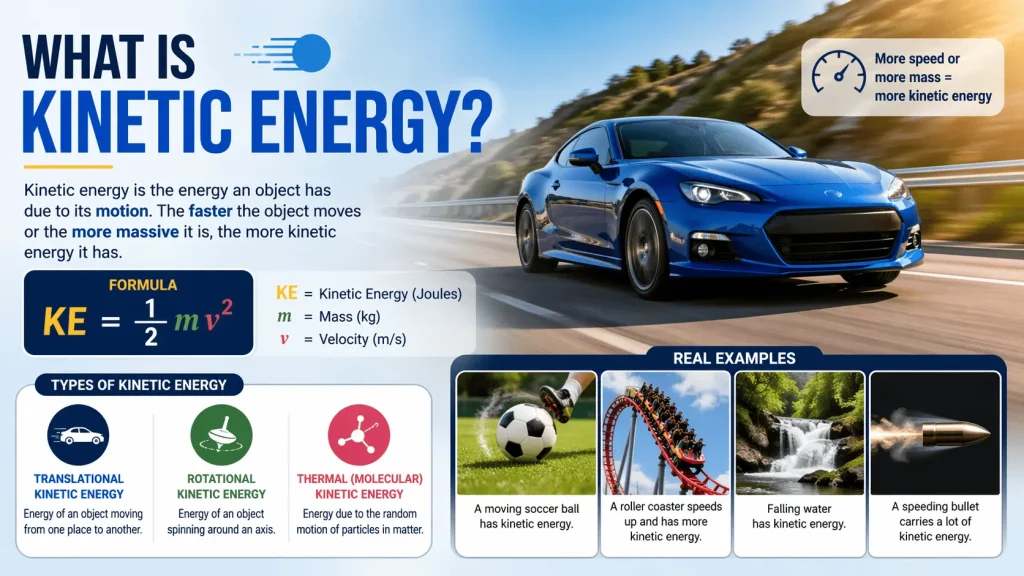
Quick answer: Kinetic energy is the energy an object has because it is moving. The faster it moves and the heavier it is, the more kinetic energy it carries. It is calculated using the formula Ek = ½mv², where m is mass in kilograms and v is speed in metres per second. The unit of kinetic energy is the joule (J).
Every moving thing has kinetic energy. The car on the motorway. The football in the air. The electrons flowing through a wire. Even the molecules in the air around you right now are moving — and every single one of them has kinetic energy.
Understanding kinetic energy is one of the most important steps in learning physics. It connects motion to energy, energy to force, and force to everything else in mechanics. Once you understand it properly, you will see it everywhere.
This guide builds that understanding from the ground up — definition first, formula second, then types, real examples with numbers, common mistakes, and every question you are likely to have.
What Kinetic Energy Actually Means
The word kinetic comes from the Greek word kinesis, meaning movement. So kinetic energy is, quite literally, movement energy.
Here is the key insight: energy is not the same as motion. Motion is a description of what an object is doing. Energy is the capacity to do work — to push, pull, heat, or change something. Kinetic energy is what happens when an object’s motion gives it that capacity.
A stationary rock sitting on the ground has no kinetic energy. The same rock rolling down a hill does have kinetic energy. That kinetic energy is what allows it to knock over a fence post, compress the ground where it lands, or heat the surface it slides across through friction. The motion has become the ability to do things.
The definition you can use in any exam: Kinetic energy is the energy an object possesses as a result of its motion. It is equal to the work that must be done on the object to bring it from rest to its current speed.
The Kinetic Energy Formula — Every Part Explained
The formula for kinetic energy is:
$$E_k = \frac{1}{2}mv^2$$
Written out: kinetic energy equals one half, times mass, times velocity squared.
| Symbol | What it stands for | Unit |
|---|---|---|
| Eₖ | Kinetic energy | Joules (J) |
| m | Mass of the object | Kilograms (kg) |
| v | Speed (velocity) of the object | Metres per second (m/s) |
| ½ | A mathematical constant — explained below | — |
Why is there a ½ in the formula?
This is the question most teachers skip and most students wonder about.
The ½ comes from the work-energy theorem. Work is defined as force multiplied by distance: W = Fd. When you accelerate an object from rest using a constant force, the distance it travels during that acceleration is not simply force times time — it involves the average speed over the acceleration period, which introduces the factor of ½.
Mathematically: if you use Newton’s second law (F = ma) and the kinematic equation v² = u² + 2as (where u = 0 at rest), and substitute into W = Fs, you get:
W = mas = m × (v²/2) = ½mv²
So the ½ is not arbitrary. It is a direct mathematical consequence of how force, acceleration, and distance relate during motion. Every joule of kinetic energy an object has is exactly equal to the work done to accelerate it from rest to its current speed.
Why is velocity squared?
This is the most important feature of the formula, and it has real-world consequences.
Doubling the speed quadruples the kinetic energy. Speed is squared, so a small increase in speed causes a large increase in kinetic energy. This is why:
- A car at 60 mph in a crash causes roughly four times more damage than a car at 30 mph — not twice as much
- Stopping distance on roads increases with the square of speed, not linearly
- Wind turbines generate much more power in strong winds — double the wind speed means up to eight times the power
The speed-squared relationship is one of the most practically important results in physics. Road safety, crash testing, aircraft design, and sports biomechanics all depend on understanding it.
How to Use the Formula — Step by Step
Here is a worked example you can follow for any kinetic energy calculation.
Question: A 1,200 kg car is travelling at 20 m/s. What is its kinetic energy?
Step 1 — Write the formula: Eₖ = ½mv²
Step 2 — Identify your values:
- m = 1,200 kg
- v = 20 m/s
Step 3 — Substitute: Eₖ = ½ × 1,200 × 20²
Step 4 — Calculate v² first: 20² = 400
Step 5 — Complete the calculation: Eₖ = ½ × 1,200 × 400 = 240,000 J = 240 kJ
What does 240,000 J mean? It means you would need to do 240,000 joules of work — through the brakes, as friction — to bring that car to a complete stop. All of that energy converts to heat in the brake pads and discs.
Now if that same car doubles its speed to 40 m/s:
Eₖ = ½ × 1,200 × 40² = ½ × 1,200 × 1,600 = 960,000 J
The speed doubled. The kinetic energy quadrupled. The braking distance roughly quadruples too.
Use our kinetic energy calculator to solve for Eₖ, mass, or speed instantly.
The Three Types of Kinetic Energy
Not all kinetic energy looks the same. There are three distinct types, each with its own formula and its own applications.
1. Translational kinetic energy
This is the most common type — the kinetic energy of an object moving from one place to another in a straight or curved path.
Formula: Eₖ = ½mv²
Examples: a car driving down a road, a ball thrown through the air, a person walking, a raindrop falling.
This is what most people mean when they say “kinetic energy” without further specification.
2. Rotational kinetic energy
This is the kinetic energy of an object spinning around an axis — not moving from place to place, but rotating.
Formula: Eₖ = ½Iω²
Where I is the moment of inertia (a measure of how the mass is distributed around the axis) and ω (omega) is the angular velocity in radians per second.
Examples: a spinning wheel, a wind turbine blade rotating, the Earth rotating on its axis, a spinning top, a flywheel in an engine.
Note that a rolling object — like a wheel rolling down a slope — has both translational and rotational kinetic energy simultaneously. Its total kinetic energy is the sum of both.
3. Vibrational kinetic energy
This is the kinetic energy of atoms and molecules oscillating back and forth around their equilibrium positions. You cannot see it with the naked eye, but it is happening constantly in every material around you.
What it looks like at the atomic level: In a solid, atoms are bonded to their neighbours but not fixed — they vibrate around their equilibrium positions. The faster they vibrate, the higher the temperature of the material.
The critical insight: Temperature is not something separate from kinetic energy. Temperature is a measure of the average vibrational kinetic energy of the molecules in a substance. When you heat something up, you are literally increasing the kinetic energy of its molecules.
| Type | What moves | Formula | Everyday example |
|---|---|---|---|
| Translational | The whole object, through space | Eₖ = ½mv² | Car, ball, raindrop |
| Rotational | The object spins around an axis | Eₖ = ½Iω² | Wind turbine, spinning top |
| Vibrational | Atoms oscillate inside the material | Related to temperature | Heat in a hot metal pan |
10 Real-World Examples of Kinetic Energy
The formula is useful. The examples make it stick.
1. A moving car
A 1,500 kg car at 30 m/s (approximately 108 km/h): Eₖ = ½ × 1,500 × 900 = 675,000 J
That is 675 kilojoules stored in the motion of the car. When the driver brakes, all of it converts to heat through friction in the brake discs. This is why brakes get hot and why worn brake pads are dangerous — they cannot absorb and dissipate that energy fast enough.
2. A falling raindrop
A raindrop has a mass of about 0.000035 kg (35 milligrams) and falls at about 9 m/s: Eₖ = ½ × 0.000035 × 81 ≈ 0.0014 J
Tiny — but multiply by the billions of raindrops in a storm, and the total kinetic energy of rainfall is enormous. Raindrop impact erodes topsoil, shapes river deltas, and polishes stone over geological time.
3. A cricket ball
A cricket ball weighs 0.156 kg. A fast bowler delivers at about 40 m/s (90 mph): Eₖ = ½ × 0.156 × 1,600 = 124.8 J
That is why being hit by a cricket ball at full pace is dangerous — 125 joules of energy is delivered to a small area of skin and bone in milliseconds.
4. A roller coaster at the bottom of a drop
A roller coaster with riders has a total mass of 8,000 kg. At the bottom of a 30-metre drop, it is travelling at approximately 24 m/s: Eₖ = ½ × 8,000 × 576 = 2,304,000 J
That 2.3 megajoules came from potential energy at the top of the drop — stored gravitational energy converting to kinetic energy as the coaster fell. This conversion between potential and kinetic energy is the entire mechanical basis of roller coaster design.
5. A wind turbine blade
A single turbine blade has a mass of about 16,000 kg and its tip moves at around 80 m/s: Eₖ = ½ × 16,000 × 6,400 = 51,200,000 J
Over 51 megajoules — just in the rotational kinetic energy of one blade. The turbine converts this constantly-renewed kinetic energy of wind into electrical energy.
6. A tennis serve
A tennis ball (0.057 kg) served at 60 m/s (the fastest serves reach 73 m/s): Eₖ = ½ × 0.057 × 3,600 = 102.6 J
The opponent has to return a ball carrying 100 joules of kinetic energy. The racket strings deform, absorbing some energy, then spring back, redirecting the ball.
7. A bullet
A 9mm bullet has a mass of about 0.008 kg and leaves the barrel at 370 m/s: Eₖ = ½ × 0.008 × 136,900 = 547.6 J
That 548 joules in an object the size of a fingertip explains the destructive capacity of firearms. The energy must be absorbed by whatever the bullet strikes.
8. A flowing river
The water in a fast-moving river section (5 m/s, 1,000 kg of water per second passing a point): Eₖ per second = ½ × 1,000 × 25 = 12,500 J per second = 12.5 kW
Hydroelectric dams extract this kinetic energy across enormous volumes of water to generate gigawatts of electricity.
9. A running human
A 70 kg person running at 4 m/s (a comfortable jogging pace): Eₖ = ½ × 70 × 16 = 560 J
This is pure translational KE. The actual metabolic energy cost of running is much higher because muscles are also doing work against internal friction, pumping blood, and maintaining posture — but the kinetic energy of the body’s motion is 560 joules.
10. An electron in a wire
An electron has a mass of 9.11 × 10⁻³¹ kg. In a copper wire, electrons drift at about 0.001 m/s: Eₖ = ½ × 9.11 × 10⁻³¹ × 0.000001 ≈ 4.5 × 10⁻³⁷ J
Vanishingly small per electron — but a typical wire carries 10²³ electrons, and their collective kinetic energy constitutes the electric current.
Kinetic Energy vs Potential Energy
These two are always discussed together because they are always converting into each other.
Kinetic energy is energy of motion — an object has it because it is moving right now.
Potential energy is stored energy — an object has it because of its position or configuration. It is energy waiting to become kinetic.
The most important type of potential energy for everyday physics is gravitational potential energy: the energy an object has because of its height above the ground. The formula is Ep = mgh (mass × gravitational field strength × height).
The conversion cycle
When you lift a ball above the ground, you do work on it. That work is stored as gravitational potential energy. When you release it, that potential energy converts to kinetic energy as it falls. Just before it hits the ground, almost all the potential energy has become kinetic energy.
At the top of a roller coaster: mostly potential energy, little kinetic energy. At the bottom of the drop: mostly kinetic energy, little potential energy.
In the absence of friction and air resistance, the total mechanical energy (Eₖ + Ep) stays constant throughout. This is the Law of Conservation of Energy — energy cannot be created or destroyed, only converted between forms.
In the real world, friction converts some kinetic energy to heat. The ball bouncing on a floor does not return to its original height because each bounce loses some energy to heat and sound. But that energy has not disappeared — it has changed form.
KE and PE — key differences at a glance
| Title | Kinetic energy | Potential energy |
|---|---|---|
| Definition | Energy of motion | Stored energy due to position or state |
| Formula | Eₖ = ½mv² | Ep = mgh (gravitational) |
| When it is zero | Object is stationary | Object is at the reference height |
| Increases when | Speed increases | Height increases |
| Converts to | PE (object slows and rises) | KE (object falls or accelerates) |
| Unit | Joules (J) | Joules (J) |
Kinetic Energy in Everyday Technology
Kinetic energy is not just a textbook concept. It is the operating principle behind some of the most important technologies humans have built.
Regenerative braking in electric cars
When an electric vehicle slows down, the motor runs in reverse — acting as a generator. Instead of converting kinetic energy to heat (as in friction brakes), it converts kinetic energy back to electrical energy and stores it in the battery. A Tesla Model 3 can recover around 20–25% of the energy it would otherwise lose to braking.
Flywheels for energy storage
A flywheel is a heavy spinning disc. Excess electrical energy spins it up (storing rotational kinetic energy). When electricity is needed, the flywheel drives a generator. Modern carbon-fibre flywheels spin at up to 60,000 rpm and can deliver power for short, intense periods — used in Formula 1 KERS systems and grid-level energy storage.
Hydroelectric power
A dam stores gravitational potential energy (water at height). Opening the sluice gates converts that potential energy to kinetic energy as water rushes downward. The kinetic energy of the water turns turbines, which turn generators. The Three Gorges Dam in China generates 22,500 megawatts this way.
Ballistic safety — crumple zones and airbags
A car crash is the rapid conversion of kinetic energy into other forms. Crumple zones in modern cars are engineered to deform during impact, absorbing kinetic energy over a longer distance and time. Longer stopping distance means lower force on passengers (F = Δp/Δt). Airbags extend the stopping time of the occupant’s head and chest, reducing peak force.
Wind turbines
Wind is moving air — it has translational kinetic energy. Turbine blades are shaped so that when wind strikes them, a pressure difference develops (like an aerofoil), creating lift that rotates the blade. The rotational kinetic energy of the blades drives a generator inside the nacelle.
Common Mistakes Students Make with Kinetic Energy
These errors appear in exam answers and homework every year. Knowing them before you make them is worth marks.
Forgetting to square the velocity. The formula is ½mv² — not ½mv. Students sometimes write ½ × mass × velocity and get an answer that is completely wrong. Always square the velocity first before multiplying.
Using km/h instead of m/s. The formula requires velocity in metres per second. If a question gives speed in km/h, convert first: divide by 3.6. A car at 72 km/h is travelling at 20 m/s.
Forgetting the ½. Some students remember ½mv² as mv² and get exactly double the correct answer every time. Write the ½ down explicitly when you write the formula.
Treating KE as a vector. Kinetic energy is a scalar quantity — it has magnitude but no direction. It is always positive (or zero). It does not matter which direction an object is moving; its kinetic energy is the same.
Confusing mass and weight. The formula uses mass in kg — not weight in newtons. If a question gives weight, divide by 9.81 to get mass.
Not checking units in the final answer. If m is in kg and v is in m/s, Eₖ comes out in joules. If you mix units — grams and metres per second, for example — your answer will be wrong by a factor of 1,000.
Frequently Asked Questions
What is kinetic energy in simple words?
Kinetic energy is the energy an object has because it is moving. The heavier the object and the faster it moves, the more kinetic energy it carries. When a moving object hits something, it transfers some or all of that kinetic energy to whatever it hits.
What is the formula for kinetic energy?
The formula is Eₖ = ½mv², where Eₖ is kinetic energy in joules, m is mass in kilograms, and v is speed in metres per second. You always square the velocity first, then multiply by mass, then divide by two — or multiply by ½.
What unit is kinetic energy measured in?
Kinetic energy is measured in joules (J). One joule is the energy needed to move an object with a force of one newton through a distance of one metre. For large amounts of energy, kilojoules (kJ) or megajoules (MJ) are used.
Can kinetic energy be negative?
No. Kinetic energy is always zero or positive. The formula ½mv² cannot produce a negative value because mass is always positive and v² (any number squared) is always positive. If an object is stationary, its kinetic energy is exactly zero. If it is moving in any direction, its kinetic energy is positive.
What happens to kinetic energy when an object stops?
It does not disappear — it converts to other energy forms. When a car brakes, kinetic energy converts to heat in the brake discs. When a ball bounces on the floor, kinetic energy converts to sound (the thud) and heat (from the deformation). When a bullet embeds in a target, kinetic energy converts to heat, sound, and the mechanical work of deforming the material.
What is the difference between kinetic energy and momentum?
Both involve a moving object, but they measure different things. Momentum (p = mv) measures how difficult it is to stop an object — it is proportional to speed. Kinetic energy (Eₖ = ½mv²) measures the energy the object carries — it is proportional to speed squared. A slow heavy object can have the same momentum as a fast light object, but their kinetic energies will differ. Both are conserved in different types of collisions.
Is kinetic energy a vector or scalar?
Kinetic energy is a scalar — it has magnitude only, no direction. It does not matter whether an object is moving left or right, up or down; its kinetic energy is always positive. This contrasts with velocity and momentum, which are vectors and have direction.
How does kinetic energy relate to temperature?
Temperature is a measure of the average kinetic energy of the particles in a substance. In a hot object, molecules vibrate faster — their average vibrational kinetic energy is higher. Absolute zero (−273.15°C or 0 K) is the temperature at which molecular kinetic energy reaches its theoretical minimum. Adding heat to an object increases the kinetic energy of its molecules.
Does kinetic energy depend on direction?
No. Kinetic energy depends on speed (the magnitude of velocity), not on the direction of motion. A ball moving right at 10 m/s has exactly the same kinetic energy as a ball of the same mass moving left at 10 m/s.
Quick Recap
- Kinetic energy is the energy an object has because of its motion
- The formula is Eₖ = ½mv² — mass in kg, speed in m/s, energy in joules
- Speed is squared — doubling speed quadruples kinetic energy
- The three types are: translational (whole object moves), rotational (object spins), and vibrational (atoms oscillate — related to temperature)
- Kinetic energy and potential energy constantly convert between each other
- The total mechanical energy (KE + PE) is conserved when there is no friction
- In the real world, friction converts kinetic energy to heat — but energy is never destroyed
- Kinetic energy is a scalar: always positive, has no direction
Part of the Physics Starter Fundamentals series. Read next: Potential Energy — Definition, Formula & Examples · Branches of Physics · Use the Kinetic Energy Calculator