Fundamentals

Quick answer: Physics is the science of how everything works — from a falling apple to a spinning galaxy. It studies matter, energy, force, and motion using clear rules called laws. This guide covers everything a beginner needs to understand physics from scratch.

What Is Physics? (The Simple Answer)

Physics is the study of how the universe works.

That sounds big. But it starts small.

When you kick a ball, physics explains why it moves. When you plug in your phone, physics explains how electricity flows. When you look at the night sky, physics explains what holds the stars in place.

Physics is not just for scientists. It is happening around you right now.

The word “physics” comes from the Greek word physis, which means “nature.” So physics is literally the science of nature — how things move, change, and interact.

Physics Fundamentals

Why Should You Learn Physics?

Most students ask this. It is a fair question.

Here are three honest answers:

It explains everyday life. Why does ice float? Why do airplanes fly? Why does your car need brakes? Physics answers all of this.

It builds strong thinking skills. Physics teaches you to look at a problem, break it into parts, and find a logical answer. That skill works in any career.

It opens every door in science and engineering. Medicine, architecture, computer science, space exploration — they all need physics at the base.

You do not need to become a scientist. But understanding physics basics makes you smarter about the world around you.

The 4 Core Concepts in Physics

Every topic in physics connects back to four big ideas. Learn these four, and everything else starts to make sense.

1. Matter

Matter is anything that takes up space and has mass. Your body, your desk, the air you breathe — all matter.

Physics studies how matter behaves, how it moves, and how it changes.

2. Energy

Energy is the ability to do work.

When you run, your body uses energy. When a light bulb glows, it uses electrical energy and turns it into light energy. When a car engine runs, it turns chemical energy (fuel) into motion.

Here is the important rule: energy never disappears. It only changes form. This is called the Law of Conservation of Energy.

3. Force

A force is a push or a pull.

Forces make things start moving, stop moving, or change direction. Gravity is a force that pulls you toward Earth. Friction is a force that slows things down. Magnetism is a force that pulls certain metals together.

Without forces, nothing would ever change.

4. Motion

Motion is when something changes position over time.

Physics uses three key ideas to describe motion:

  • Speed — how fast something moves
  • Velocity — how fast and in which direction
  • Acceleration — how quickly speed or direction changes

These four concepts — matter, energy, force, and motion — form the foundation of everything in physics.

The 5 Most Important Laws of Physics (Explained Simply)

Laws in physics are not rules that humans made up. They are patterns that scientists discovered by watching nature over and over again. These patterns never change.

Here are the five you need to know.

Law 1 — Newton’s Three Laws of Motion

Isaac Newton figured these out in 1687. They still explain almost everything that moves.

First Law (Inertia): Objects keep doing what they are doing. A still object stays still. A moving object keeps moving. Nothing changes unless a force acts on it.

Example: A book on a table stays there until you push it. A hockey puck on ice keeps sliding until friction or a wall stops it.

Second Law (F = ma): The bigger the force on an object, the faster it accelerates. The heavier the object, the more force you need.

Example: Pushing a shopping cart when it is empty is easy. Push it when it is full of groceries and you need to push much harder to move it at the same speed.

Third Law (Action-Reaction): Every action has an equal and opposite reaction.

Newton's Law

Example: When you jump, you push down on the ground. The ground pushes back up on you. That push is what launches you into the air.

Law 2 — The Law of Universal Gravitation

Newton also discovered this one. Every object in the universe pulls every other object toward it. This pull is called gravity.

The bigger and heavier the object, the stronger its gravitational pull.

Example: Earth is massive, so it pulls everything toward its center. That is why your feet stay on the ground. The Moon is less massive, so gravity on the Moon is about 6 times weaker than on Earth. Astronauts bounce there because they weigh much less.

Law 3 — Conservation of Energy

Energy cannot be created or destroyed. It can only change from one form to another.

Example: A roller coaster at the top of a hill has lots of stored energy (called potential energy). As it rolls down, that stored energy turns into motion energy (called kinetic energy). At the bottom, it is moving fastest. None of the energy disappeared. It just changed form.

Law 4 — Laws of Thermodynamics

These laws are about heat and energy transfer. There are three of them, but the two most important for beginners are:

First Law: You cannot create energy from nothing. (Same as Conservation of Energy.)

Second Law: Heat always flows from hot things to cold things. Never the other way around.

Example: A hot cup of tea cools down on its own. It never heats up on its own. That is the second law of thermodynamics at work.

Law 5 — Electromagnetic Theory (Faraday and Maxwell)

Electric charges and magnetic fields are connected. A moving electric charge creates a magnetic field. A changing magnetic field creates an electric current.

Example: This is how electric generators work. A spinning magnet near a wire pushes electrons through the wire and creates electricity. Every power plant on Earth uses this principle.

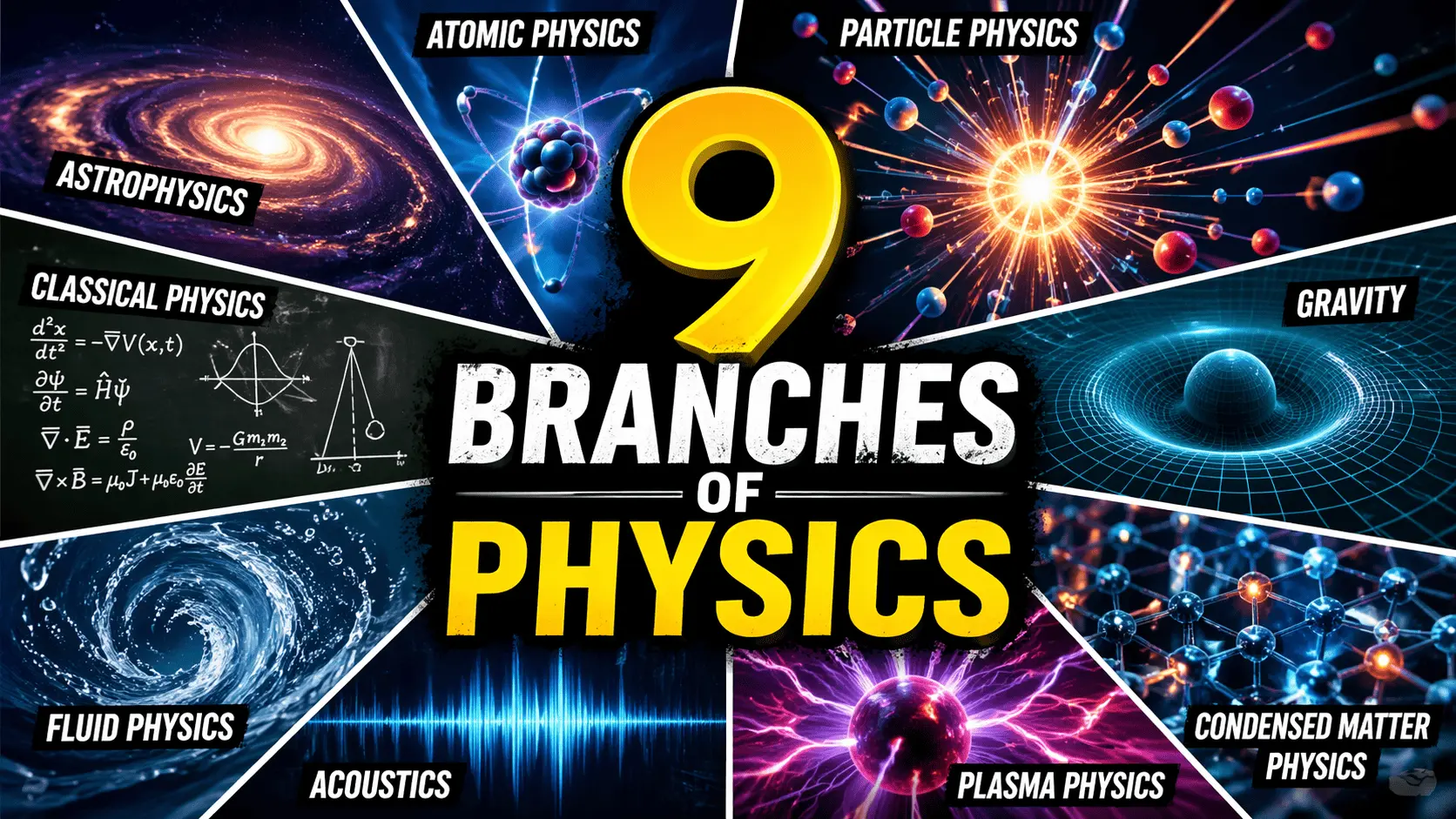
The Main Branches of Physics

Physics is a huge subject. Scientists split it into smaller areas to study each one deeply.

Here are the main branches you will hear about:

BranchWhat It StudiesExample
Classical MechanicsMotion and forcesHow a baseball flies through the air
ThermodynamicsHeat and energyHow an engine converts fuel into motion
ElectromagnetismElectric and magnetic forcesHow your phone charges
OpticsLight and how it behavesWhy a straw looks bent in a glass of water
Quantum MechanicsBehavior of tiny particlesHow a computer chip works
RelativitySpace, time, and gravity at huge scalesHow GPS satellites stay accurate
Nuclear PhysicsAtomic nuclei and radioactivityHow nuclear power plants generate electricity
AstrophysicsStars, galaxies, and the universeWhy black holes exist

You do not need to learn all of these at once. This site covers each one step by step, starting with the basics.

Physics in Your Daily Life (Real Examples)

Physics is not stuck in a textbook. Look around and you will see it everywhere.

Your smartphone uses electromagnetism to send and receive signals. The touchscreen works because your finger changes an electric field. The camera uses optics to focus light. The battery stores chemical energy and turns it into electrical energy.

Your car uses Newton’s second law every time it accelerates. The brakes use friction to slow you down. Airbags are designed using physics to stop your body as gently as possible during a crash.

Physics in real life

A building stands up because engineers calculated forces using physics. Every beam, every column, every floor is placed to balance forces perfectly.

Cooking uses thermodynamics. When you boil water, heat energy moves from the stove to the pot to the water. The water temperature rises until it changes state from liquid to steam.

Physics is not happening somewhere else. It is happening right here, right now, all around you.

Common Physics Mistakes Beginners Make

Knowing what trips people up helps you avoid it.

Mistake 1: Confusing mass and weight. Mass is how much matter something contains. Weight is the force gravity pulls on that mass. Your mass is the same on Earth and the Moon. Your weight is much less on the Moon because gravity is weaker there.

Mistake 2: Thinking heavier objects fall faster. They do not. Galileo proved this in the 1500s. In a vacuum, a feather and a cannonball hit the ground at the same time. On Earth, air resistance makes light objects slower — not gravity.

Mistake 3: Thinking Newton’s Third Law means forces cancel out. Action and reaction forces act on different objects. When you punch a wall, the wall pushes back on your hand. Those two forces do not cancel because they act on different things (the wall and your hand).

How to Start Learning Physics (If You Are a Beginner)

Follow this order. It works.

Step 1 — Start with mechanics. Learn about motion, force, and Newton’s laws first. Everything in physics builds on top of this.

Step 2 — Learn about energy. Understand kinetic energy, potential energy, and how they convert. This connects mechanics to thermodynamics and electricity.

Step 3 — Study electricity and magnetism. Once you understand forces and energy, electricity makes much more sense.

Step 4 — Move to waves and optics. Sound and light both behave as waves. This prepares you for modern physics.

Step 5 — Explore modern physics. Quantum mechanics and relativity come last because they challenge everything you thought was simple. But if you follow the steps above, they will be far easier to grasp.

This site follows this exact order. Start with the first guide in each section and work your way through.

Quick Recap — Physics Fundamentals in Plain English

  • Physics is the science of matter, energy, force, and motion
  • Everything in the universe follows the same physical laws
  • Newton’s laws explain almost all everyday motion
  • Energy never disappears — it just changes form
  • Heat always moves from hot to cold, never the reverse
  • Electricity and magnetism are two sides of the same force
  • Physics is happening in your phone, your car, your kitchen, and the sky above you

Frequently Asked Questions

What are the basics of physics for beginners? Start with four ideas: matter, energy, force, and motion. Once you understand these, every other topic in physics connects back to them. Newton’s three laws of motion are the best starting point.

What is the most important law in physics? Most physicists point to the Law of Conservation of Energy. It applies everywhere — in mechanics, electricity, thermodynamics, and even quantum physics. Nothing in the universe creates energy from nothing.

Is physics hard to learn? Physics feels hard when you start with equations before understanding the ideas. Start with the concept. Understand what is happening and why. Then the math becomes a tool for measuring something you already understand.

What is the difference between physics and chemistry? Physics studies energy and forces at a large scale. Chemistry studies how atoms and molecules interact. They overlap in areas like atomic physics and thermodynamics. But physics focuses more on fundamental laws, while chemistry focuses on reactions and materials.

How does physics connect to everyday life? Every device you use, every vehicle you ride in, every building you enter was built using physics. Smartphones, aeroplanes, bridges, X-ray machines, solar panels — all designed with physics principles at the core.

What branch of physics should a beginner start with? Start with classical mechanics. It covers motion and forces using Newton’s laws — the most straightforward part of physics. It requires basic math and gives you a strong foundation for every other branch.

Can I learn physics without knowing advanced math? Yes, especially at the beginner level. Most fundamental concepts in physics can be understood through logic and simple arithmetic. You need stronger math for advanced topics, but the ideas make sense long before the equations do.


Continue learning: Explore the full Mechanics guide, or jump into Electricity & Magnetism if you are studying for an exam.