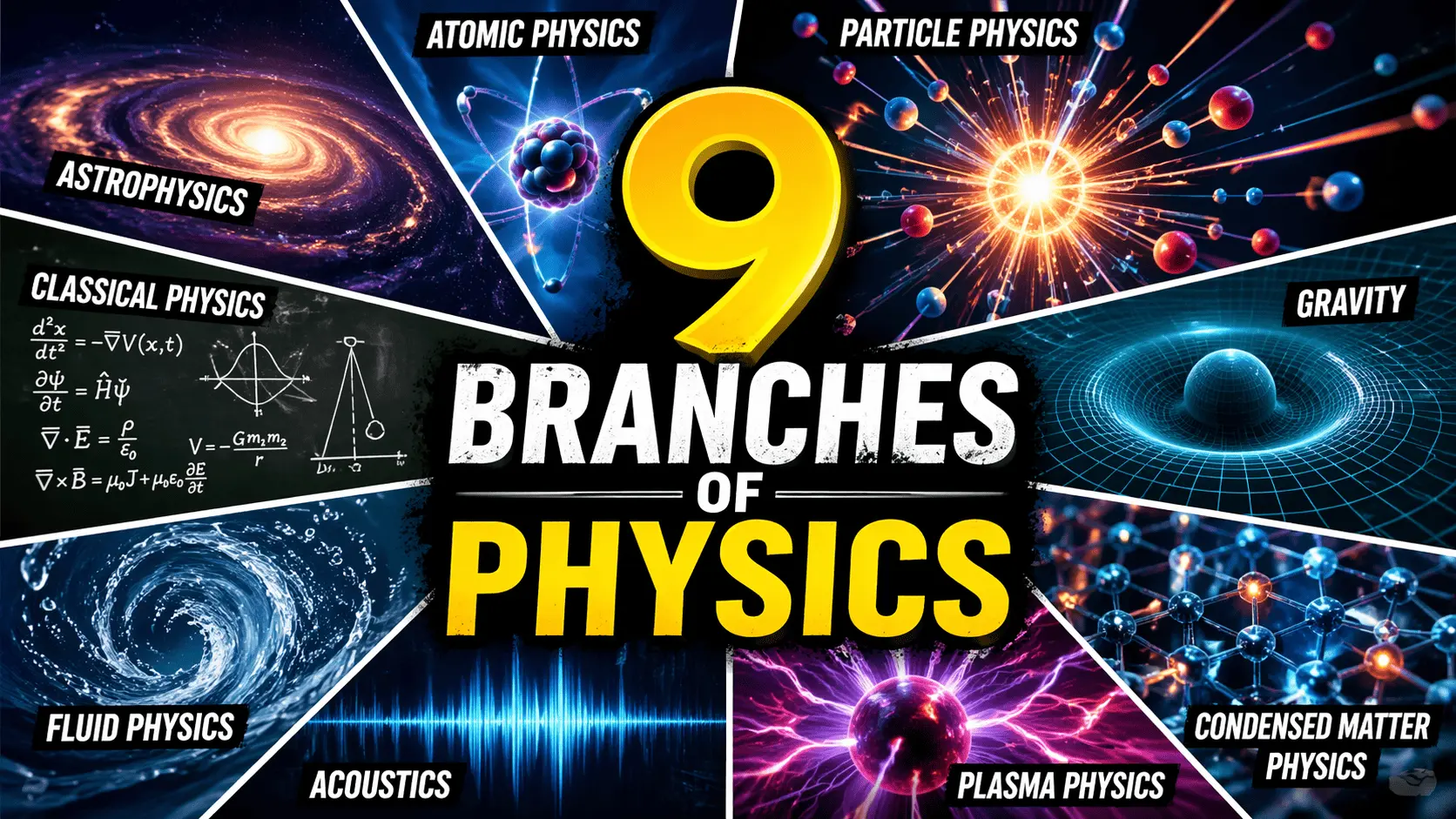
Quick answer: Physics is divided into 9 major branches — classical mechanics, thermodynamics, electromagnetism, optics, acoustics, quantum mechanics, relativity, nuclear physics, and astrophysics. Each branch studies a specific type of matter or energy interaction. They are not separate sciences. They are different lenses pointed at the same universe, and they feed into each other constantly.
Physics started as one thing — the attempt to understand why the world behaves the way it does.
But as physicists kept asking questions, they discovered that different phenomena needed different tools. The physics of a moving cannonball needed different mathematics than the physics of a glowing light bulb. The physics of a gas needed different concepts than the physics of a radioactive atom.
That is how branches formed. Not by committee decision, but because reality itself has distinct levels and domains that each require their own framework.
This guide explains each branch in plain language — what it studies, why it exists, what technology it produced, and how it connects to the others. By the end you will understand not just what the branches are, but how the entire field of physics hangs together as one unified story.
The Two Parent Categories: Classical and Modern Physics
Before listing individual branches, you need to understand one dividing line that physicists draw across the entire field.
Classical physics — the world you can see
Classical physics covers everything understood before roughly 1900. It describes the world at the scale of things you can see, touch, and measure with basic instruments. A thrown ball. A heated gas. A current through a wire. A beam of light bending through glass.
Classical physics works extremely well at everyday scales. Engineers use it every day to design buildings, cars, and power grids. The fact that it breaks down at the scale of atoms or the speed of light does not make it wrong — it makes it approximate. And approximate is all you need for most real-world problems.
Classical physics contains five branches: mechanics, thermodynamics, electromagnetism, optics, and acoustics.
Modern physics — the world you cannot see
Modern physics covers everything that emerged after 1900. It describes phenomena that classical physics simply could not explain — why atoms emit specific colours of light, why matter behaves like a wave, why time slows down near a massive star.
Modern physics is not a replacement for classical physics. It is an extension. At everyday scales, modern physics gives the same answers as classical physics. Modern physics just works where classical physics stops working.
Modern physics contains four major branches: quantum mechanics, relativity, nuclear physics, and astrophysics.
| When | Classical physics | Modern physics |
|---|---|---|
| Era | Before ~1900 | After ~1900 |
| Scale | Everyday — visible world | Atomic scale or extreme conditions |
| Branches | Mechanics, thermodynamics, electromagnetism, optics, acoustics | Quantum mechanics, relativity, nuclear physics, astrophysics |
| Do they conflict? | No — consistent at everyday scales. Modern physics is the more complete version; classical is the useful approximation. |
The dividing event: Classical physics failed to explain blackbody radiation in 1900 and the photoelectric effect in 1905. Both required quantum explanations. That failure launched modern physics.
The 9 Major Branches — Each Explained Simply
1. Classical Mechanics — The Physics of Motion
What it studies: Forces, motion, momentum, energy — everything that moves or pushes.
The question it was invented to answer: Why do objects move the way they do?
When you push something, it accelerates. When you throw something, it follows a curved path. When two objects collide, their total momentum is conserved. All of this is mechanics.
The founding moment — Isaac Newton, 1687. Newton published Principia Mathematica and gave mechanics its mathematical foundation. He showed that the same laws governing a falling apple on Earth also govern the orbit of the Moon. Nobody had proved before that earthly physics and cosmic physics followed the same rules. It was one of the greatest intellectual achievements in history.
What mechanics covers
- Kinematics — how objects move (velocity, acceleration, displacement) without asking why
- Dynamics — why objects move (forces, Newton’s three laws, momentum)
- Work and energy — how energy transfers between objects and converts between kinetic and potential forms
- Rotational mechanics — spinning, torque, angular momentum
- Fluid mechanics — how liquids and gases move, from blood in arteries to air over an aircraft wing
What it produced: Every machine ever built. Car engines, aircraft wings, bridge designs, spacecraft trajectories, sports equipment, robotics. Mechanics is the foundation every engineer builds on.
The key insight: Forces cause changes in motion, not motion itself. An object moving at constant speed in a straight line has no net force acting on it. This is Newton’s first law — and it is deeply counter-intuitive, which is why it took until 1687 for someone to state it correctly.
2. Thermodynamics — The Physics of Heat and Energy
What it studies: Heat, temperature, energy transfer, and the rules governing engines and efficiency.
The question it was invented to answer: How do you make a steam engine as efficient as possible?
Thermodynamics was born from a very practical 19th-century problem. The answer required a new branch of physics.
Heat is not a substance that flows between objects like water through a pipe. Heat is the transfer of energy caused by a temperature difference. Thermodynamics defines what temperature actually is, explains why heat always flows from hotter to colder objects, and proves why no engine can ever be 100% efficient.
The founding moment — Sadi Carnot, 1824. Carnot proved mathematically that there is a maximum efficiency any heat engine can achieve, regardless of how well it is built. This maximum depends only on the temperatures of the hot and cold reservoirs — not on the design. No engineering cleverness can beat the Carnot limit.
The four laws of thermodynamics
- Zeroth law: If two objects are each in thermal equilibrium with a third object, they are in thermal equilibrium with each other. This is how thermometers work.
- First law: Energy cannot be created or destroyed — only converted. The total energy of a closed system is constant.
- Second law: Entropy (disorder) in an isolated system always increases or stays the same. Heat flows from hot to cold. Engines cannot be 100% efficient.
- Third law: As temperature approaches absolute zero, entropy approaches a minimum. You cannot reach absolute zero in a finite number of steps.
What it produced: Every engine, every refrigerator, every air conditioner, every power station. Modern understanding of climate change relies on thermodynamics. The efficiency limits of solar panels and batteries are set by thermodynamic laws.
The second law is the most profound statement in classical physics. It gives time a direction. A broken glass does not spontaneously reassemble because that would require entropy to decrease. Physics allows it mathematically — the probability is just so close to zero that it never happens in practice.
3. Electromagnetism — The Physics of Electricity and Magnetism
What it studies: Electric charges, magnetic fields, electromagnetic waves — light, radio, Wi-Fi.
The question it was invented to answer: What are electricity and magnetism, and are they related?
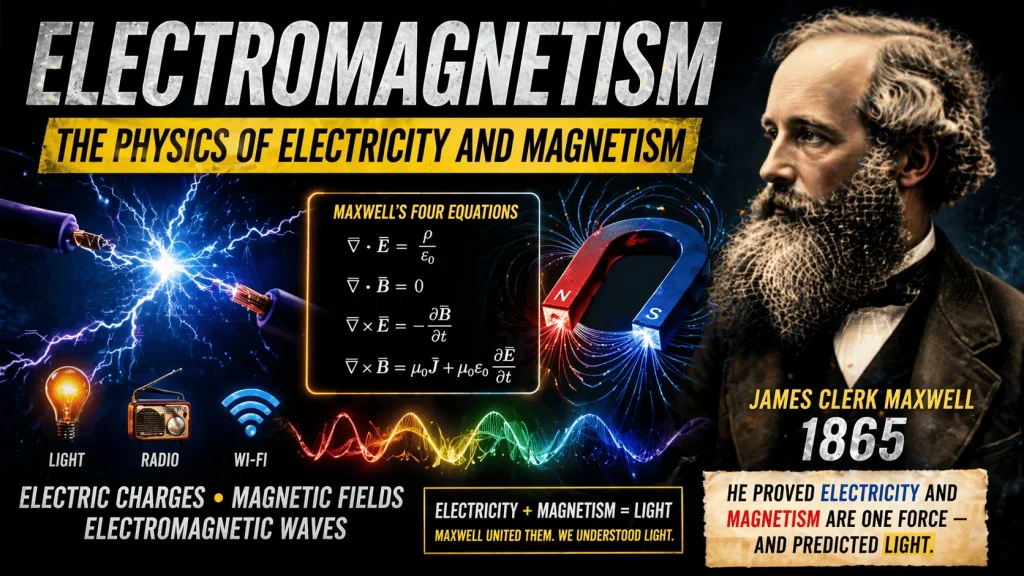
For most of history, electricity and magnetism were thought to be completely separate. Electricity was about sparks. Magnetism was about lodestones pointing north. In 1865, James Clerk Maxwell proved they are the same force.
The founding moment — James Clerk Maxwell, 1865. Maxwell’s four equations compressed the entire theory of electromagnetism into four mathematical statements. They predicted that electromagnetic waves must exist and must travel at a specific speed. When he calculated that speed, it matched the known speed of light exactly. In proving this, Maxwell had not only unified electricity and magnetism — he had explained what light is.
What electromagnetism covers
- Electrostatics — forces between stationary electric charges
- Magnetostatics — forces between magnets and between current-carrying conductors
- Electromagnetic induction — how changing magnetic fields create electric currents (the basis of generators and transformers)
- Electromagnetic waves — light, radio waves, microwaves, X-rays, gamma rays — all the same phenomenon at different frequencies
- Circuits — how voltage, current, resistance, and power relate in electrical systems
What it produced: Every electrical device on Earth. Generators, motors, transformers, radio, television, mobile phones, Wi-Fi, MRI scanners, laser surgery, satellite communications. Maxwell’s equations are arguably the most practically productive piece of physics ever written.
4. Optics — The Physics of Light
What it studies: How light travels, reflects, refracts, bends, and carries information.
The question it was invented to answer: Why does a pencil look bent in water? How does a lens focus light? Why does a prism split white light into colours?
The answer to all three comes from one principle: light travels at different speeds through different materials. When it crosses from one material to another at an angle, it bends. The amount it bends depends on the refractive indices of the two materials.
After Maxwell’s work, optics became a special case of electromagnetism. Light is an electromagnetic wave. Reflection and refraction are electromagnetic effects at the interface between materials.
The two domains of optics
- Geometric optics — treats light as straight rays that reflect and refract. Explains mirrors, lenses, cameras, microscopes, telescopes. Ignores the wave nature of light.
- Physical optics (wave optics) — treats light as a wave. Explains interference, diffraction, polarisation. Needed to understand holograms, optical fibres, and the resolution limits of microscopes.
What it produced: Spectacles, microscopes, telescopes, cameras, lasers, optical fibre internet, LED lighting, solar cells, barcode scanners, LiDAR in self-driving cars.
5. Acoustics — The Physics of Sound
What it studies: Sound waves — how they travel, how they are produced, how they are heard.
The core idea: Sound is a pressure wave. When a speaker cone vibrates, it pushes and pulls the air molecules around it. Those molecules push and pull their neighbours. The disturbance travels outward as a wave. When it reaches your eardrum, it vibrates it, and your brain interprets the signal as sound.
Sound cannot travel through a vacuum because there is no medium for the pressure wave to travel through. This is why space is silent.
What acoustics covers
- Sound propagation — how sound travels through different media and at different speeds
- Interference and resonance — why musical instruments produce specific notes, why some rooms echo badly
- The Doppler effect — why a passing ambulance sounds higher pitched as it approaches and lower as it recedes
- Ultrasound — sound above the range of human hearing, used in medical imaging and industrial testing
- Architectural acoustics — designing concert halls, recording studios, and soundproofing for buildings
What it produced: Sonar navigation, ultrasound medical imaging, noise-cancelling headphones, concert hall design, audio engineering, earthquake detection, and echolocation technology used in robotics.
6. Quantum Mechanics — The Physics of the Very Small
What it studies: The behaviour of matter and energy at the scale of atoms and subatomic particles.
Quantum mechanics is the most precisely tested theory in the history of science. Its predictions have been confirmed to more than ten decimal places — a level of accuracy unmatched by any other framework in any field.
It emerged because classical physics could not explain what happened at the atomic scale. When you heat metal, it glows. The colour depends on temperature. Classical physics predicted the glow should be infinitely bright in the ultraviolet — which is obviously wrong. Max Planck solved this in 1900 by proposing that energy comes in discrete packets, which he called quanta.
The founding moment — Max Planck, 1900. Extended by Einstein (1905), Bohr (1913), Heisenberg and Schrödinger (1925–26).
The three properties of quantum mechanics that break everyday intuition
- Quantisation — energy, momentum, and other quantities only exist in discrete steps, not on a continuous scale. An electron in an atom can only have specific energies. This is why atoms emit specific colours of light instead of a continuous spectrum.
- Wave-particle duality — everything — electrons, photons, even atoms — behaves as both a particle and a wave depending on how you observe it. The double-slit experiment shows electrons interfering with themselves, which only makes sense if each electron passes through both slits simultaneously as a wave.
- The uncertainty principle — you cannot know both the exact position and exact momentum of a particle at the same time. This is not a measurement limitation — it is a fundamental property of reality. The more precisely you know where a particle is, the less you can know about how fast it is moving.
What it produced: The transistor (1947) — which gave us computers, smartphones, and the entire digital world. Also: lasers, LED lights, MRI machines, atomic clocks, solar cells, and the entire science of chemistry (because chemical bonding is explained by quantum mechanics).
The transistor was invented by scientists who understood quantum mechanics. Without quantum mechanics there are no transistors. Without transistors there are no computers. Without computers there is no internet, no smartphone, no GPS. Quantum mechanics is not an obscure academic theory — it is the foundation of the modern economy.
7. Relativity — The Physics of Space, Time, and Gravity
What it studies: How space, time, and gravity behave at very high speeds or near massive objects.
Albert Einstein published two theories of relativity: special relativity in 1905 and general relativity in 1915. Together they changed our understanding of space, time, and gravity more fundamentally than any discovery since Newton.
Special relativity (1905) — motion at near-light speeds
Einstein started with one assumption: the speed of light is the same for all observers, regardless of how they are moving. From this single starting point, he derived consequences that sound impossible.
- Time dilation — time passes more slowly for objects moving at high speeds. An astronaut who travels close to the speed of light and returns home will have aged less than the people who stayed behind. GPS satellites move fast enough that their clocks lose 7 microseconds per day — engineers must correct for this or GPS would drift by kilometres daily.
- Length contraction — objects moving at high speeds are shorter in the direction of motion, from a stationary observer’s perspective.
- Mass-energy equivalence — E = mc². Mass is concentrated energy. A tiny amount of mass converts to an enormous amount of energy — the principle behind both nuclear reactors and nuclear weapons.
General relativity (1915) — gravity as curved spacetime
Einstein’s second theory replaced Newton’s law of gravity. In general relativity, gravity is not a force acting across empty space. Gravity is the curvature of spacetime caused by the presence of mass and energy. Objects follow curved paths through spacetime not because they are pulled, but because spacetime itself is curved.
Confirmed predictions: Bending of light around massive objects (confirmed 1919), gravitational time dilation (clocks run slower in stronger gravity), gravitational waves (detected 2015), black holes (imaged 2019).
What it produced: GPS (requires both special and general relativity corrections), nuclear energy, particle accelerators, gravitational wave detectors, black hole research, and modern cosmology.
8. Nuclear Physics — The Physics of Atomic Nuclei
What it studies: The structure of atomic nuclei, radioactive decay, and nuclear reactions — fission and fusion.
The atomic nucleus is about 100,000 times smaller than the atom itself. The strong nuclear force binds protons and neutrons together — it is the most powerful force in nature, but it only acts over distances smaller than a nucleus.
The founding moment — Ernest Rutherford, 1911. Rutherford fired alpha particles at a thin gold foil and expected them to pass straight through. Most did. But some bounced straight back. This proved that the atom has a tiny, dense, positively charged nucleus — demolishing the previous model and launching nuclear physics as a discipline.
The four key processes in nuclear physics
- Alpha decay — a nucleus emits a helium nucleus (two protons, two neutrons). The atom transforms into a different element.
- Beta decay — a neutron converts to a proton (or vice versa), emitting an electron and a neutrino. Used in medical imaging (PET scans).
- Fission — a heavy nucleus splits into two smaller nuclei, releasing enormous energy. This is how nuclear reactors and atomic bombs work.
- Fusion — two light nuclei merge into a heavier nucleus, releasing even more energy per kilogram than fission. This is how the Sun produces energy. Controlled fusion on Earth is the holy grail of clean energy.
What it produced: Nuclear power stations (providing ~10% of global electricity), cancer radiotherapy, PET scans, diagnostic isotopes, carbon dating in archaeology, smoke detectors.
9. Astrophysics — The Physics of the Universe
What it studies: Stars, galaxies, black holes, dark matter, and the large-scale structure of the universe.
Astrophysics applies all the other branches of physics to objects in space — stars, planets, galaxies, nebulae, black holes, and the universe as a whole. It is physics with the entire universe as its laboratory.
A star is not just a bright object in the sky. It is a nuclear fusion reactor balanced between gravity (trying to collapse it) and radiation pressure (trying to explode it). Understanding it requires thermodynamics, nuclear physics, electromagnetism, and general relativity simultaneously.
What astrophysics covers
- Stellar physics — how stars form, shine, and die. The Sun fuses 620 million tonnes of hydrogen every second.
- Cosmology — the origin, structure, and ultimate fate of the universe. The Big Bang. Dark matter. Dark energy. The expansion of space.
- Black holes — regions of spacetime so curved that nothing, not even light, can escape. First imaged in 2019.
- Gravitational waves — ripples in spacetime caused by massive accelerating objects. Detected in 2015 by LIGO.
- Exoplanets — planets orbiting other stars. More than 5,600 confirmed and counting.
What it produced: Satellites, weather forecasting, telecommunications, solar panel design informed by understanding the Sun’s spectrum, and the most profound answers to the oldest human question: where did we come from?
All 9 Branches at a Glance
| Branch | Category | Studies | Technology it produced |
|---|---|---|---|
| Mechanics | Classical | Forces, motion, energy, momentum | Every machine, vehicle, and structure |
| Thermodynamics | Classical | Heat, temperature, energy transfer | Engines, refrigerators, power stations |
| Electromagnetism | Classical | Electricity, magnetism, EM waves | Phones, Wi-Fi, MRI, radio, motors |
| Optics | Classical | Light, lenses, reflection, refraction | Cameras, lasers, fibre-optic internet |
| Acoustics | Classical | Sound waves, vibration, resonance | Sonar, ultrasound imaging, audio tech |
| Quantum mechanics | Modern | Atoms, electrons, wave-particle duality | Transistors, computers, LEDs, solar cells |
| Relativity | Modern | Space, time, gravity at extreme scales | GPS, nuclear energy, gravitational wave detectors |
| Nuclear physics | Modern | Atomic nuclei, fission, fusion, decay | Nuclear power, cancer treatment, dating techniques |
| Astrophysics | Modern | Stars, galaxies, black holes, the universe | Satellites, deep space understanding, cosmology |
How the Branches Connect — The Chain of Physics
Physics is not a collection of disconnected subjects. The branches grew out of each other and feed into each other constantly.
Mechanics → Thermodynamics
Classical mechanics describes individual particles. Thermodynamics describes what happens when you have trillions of particles all moving at once. Temperature is just the average kinetic energy of molecules — a mechanics concept applied at enormous scale. The link between them is statistical mechanics, developed by Boltzmann and Maxwell in the 1860s–1880s.
Electromagnetism → Optics
Optics existed as an observational science for centuries before Maxwell. After his 1865 equations, optics became a special case of electromagnetism. Light is an electromagnetic wave. Reflection and refraction are electromagnetic effects at interfaces between materials. The two branches are now unified under electromagnetic theory.
Classical physics → Quantum mechanics
Every branch of classical physics eventually ran into phenomena it could not explain:
- Thermodynamics could not explain the spectrum of blackbody radiation.
- Electromagnetism could not explain why atoms are stable — an orbiting electron should continuously radiate energy and spiral into the nucleus.
- Optics could not explain the photoelectric effect.
Quantum mechanics resolved all three simultaneously. It is not a patch on classical physics — it is a deeper layer beneath it.
Quantum mechanics + Electromagnetism → Quantum electrodynamics (QED)
Quantum electrodynamics is the union of quantum mechanics and electromagnetism. It describes how light and matter interact at the quantum level. It is the most precisely tested theory in science — predictions match experiment to more than ten decimal places.
Mechanics + Thermodynamics + Nuclear physics → Astrophysics
A star is a fusion reactor (nuclear physics) held together by gravity (mechanics) with energy transported from core to surface by radiation (electromagnetism and thermodynamics). Understanding a star requires all three classical branches and nuclear physics working simultaneously. Astrophysics is where every other branch meets.
Frequently Asked Questions
How many branches of physics are there?
There are 9 major branches: classical mechanics, thermodynamics, electromagnetism, optics, acoustics, quantum mechanics, relativity, nuclear physics, and astrophysics. Within each major branch there are dozens of sub-fields — fluid mechanics sits within mechanics, quantum field theory sits within quantum mechanics, cosmology sits within astrophysics. Different sources give different counts depending on how finely they divide sub-fields.
What is the oldest branch of physics?
Classical mechanics is the oldest. It became a formal scientific discipline when Galileo Galilei made physics mathematical and experimental in the early 1600s, and reached its definitive form when Isaac Newton published Principia Mathematica in 1687. Those laws of motion and universal gravitation still underpin engineering today.
What is the newest branch of physics?
Astrophysics as a modern observational and theoretical science developed through the 20th century. Quantum chromodynamics — the theory of how quarks interact inside protons and neutrons — was developed in the 1970s. String theory and loop quantum gravity, which attempt to unify quantum mechanics and general relativity, are still actively developing. The newest frontier is quantum information science.
Which branch of physics is the hardest?
This depends on your background. Most students find quantum mechanics hardest because it requires abandoning intuitions built from everyday experience. Nothing in ordinary life prepares you for a particle that can be in two states simultaneously. General relativity is mathematically demanding — it requires tensor calculus. Nuclear physics involves the most complex atomic structure mathematics.
Which branches of physics are covered at A Level?
A Level Physics covers mechanics, waves and optics, electricity and magnetism, thermal physics, and an introduction to nuclear physics and quantum phenomena. Specific topics include kinematics, Newton’s laws, work and energy, oscillations, electromagnetism, electric fields, capacitors, radioactive decay, and the photoelectric effect.
What is the difference between classical and modern physics?
Classical physics covers mechanics, thermodynamics, electromagnetism, optics, and acoustics — everything understood before approximately 1900. Modern physics covers quantum mechanics, relativity, nuclear physics, and astrophysics — everything that emerged from the crises classical physics could not resolve. Classical physics is an excellent approximation at everyday scales. Modern physics is required when objects move at near the speed of light or when phenomena occur at the atomic scale.
Is mathematics a branch of physics?
No. Mathematics is the language of physics, not a branch of it. Physics uses mathematics to express its laws with precision. But mathematics does not require physical reality — it is the study of abstract structures and relationships. Some areas sit at the boundary, like mathematical physics, but mathematics and physics remain distinct disciplines with different goals and methods.
What branch of physics deals with electricity?
Electromagnetism is the branch that covers electricity, magnetism, and the relationship between them. It includes circuit theory, electromagnetic induction, and the full spectrum of electromagnetic waves — from radio waves to gamma rays.
What branch of physics deals with light?
Optics is the branch dedicated to light — how it travels, reflects, refracts, and behaves as a wave. Since Maxwell unified electricity and magnetism in 1865, optics has also been understood as a sub-field of electromagnetism. Light is an electromagnetic wave.
Quick Recap
- Physics has 9 major branches, divided into classical (pre-1900) and modern (post-1900) categories
- Classical branches: mechanics, thermodynamics, electromagnetism, optics, acoustics — describe the everyday world accurately
- Modern branches: quantum mechanics, relativity, nuclear physics, astrophysics — extend physics to atomic scales and extreme conditions
- The branches are not isolated — they grew out of each other and remain deeply connected
- Every technology you use was built on at least one branch of physics
- Quantum mechanics is the most precisely tested theory in science and the foundation of all digital technology
- Astrophysics applies every other branch simultaneously to study the universe at the largest possible scale
Part of the Physics Starter Fundamentals series. Read next: What is matter · What Is Physics? · Explore our Physices Fundamentals