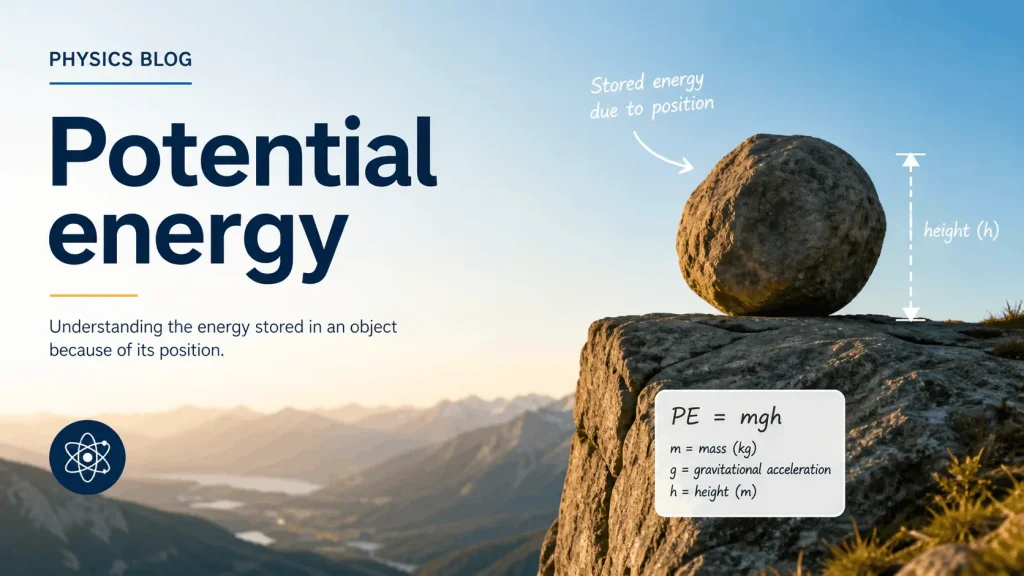
Potential energy is the energy an object stores because of its position, shape, or chemical state. It is not energy in motion – it is energy waiting to become motion. A rock at the top of a cliff has potential energy. A compressed spring has it. The food in your stomach has it. When the right conditions are met, that stored energy converts to kinetic energy – the energy of movement.
You have experienced potential energy hundreds of times today without naming it.
Every time you climbed a step, you stored gravitational potential energy in your body. Every time you pulled back a rubber band, you stored elastic potential energy. Every time you ate food, you consumed chemical potential energy. Understanding potential energy means understanding where energy hides before it moves.
This guide builds that understanding completely — definition, formula derivation, all five types, worked calculations, and how potential energy connects to everything else in physics.
What Is Potential Energy? – The Direct Answer
Potential energy is stored energy that an object or system possesses because of its position relative to other objects, its internal configuration, or its chemical or nuclear state.
The word potential means capable of becoming something. Potential energy is energy that has not yet done work but is capable of doing it when released.
Three things determine how much potential energy something has:
- What type of force is acting on it — gravity, an elastic restoring force, electromagnetic force, or nuclear force
- How much the object is displaced from its natural equilibrium — height above the ground, how far a spring is stretched, how far a charge is from another charge
- The strength of the force involved — a stronger gravitational field means more potential energy per kilogram per metre
Potential energy is defined as the energy stored in an object due to its position, configuration, or state. It is a scalar quantity measured in joules (J). The most common form is gravitational potential energy, calculated using Ep = mgh, where m is mass in kilograms, g is gravitational field strength (9.81 N/kg on Earth), and h is height in metres above a chosen reference point.
The Gravitational Potential Energy Formula — Every Part Explained
The formula you will use most often in physics is:
$$E_p = mgh$$
| Symbol | Meaning | Unit |
|---|---|---|
| Ep | Gravitational potential energy | Joules (J) |
| m | Mass of the object | Kilograms (kg) |
| g | Gravitational field strength | N/kg (= 9.81 on Earth’s surface) |
| h | Height above the reference point | Metres (m) |
Where does mgh come from?
Most textbooks give you this formula without explaining why it is what it is. Here is the derivation — it takes three steps and makes the formula unforgettable.
Step 1 — Define work done. Work is done when a force moves an object through a distance. The formula is: W = F × d
Step 2 — Identify the force needed to lift an object. To lift an object at constant speed (no acceleration), you must apply an upward force exactly equal to its weight. Weight = mg (mass × gravitational field strength). So F = mg.
Step 3 — Substitute into the work formula. If you lift the object through a height h, the distance d = h. W = F × d = mg × h = mgh
The work you did to lift the object is now stored as gravitational potential energy. That is why Ep = mgh — it is exactly equal to the work done against gravity to raise the object to height h. Every joule of gravitational PE you give an object required exactly one joule of work to put it there.
The key insight: Potential energy is stored work. Whenever you do work against a force — lifting against gravity, compressing a spring against its restoring force, separating charges against electromagnetic attraction — that work is stored as potential energy of that system.
How to Calculate Potential Energy — Step by Step
HowTo schema — optimised for Google’s How-To rich result:
Calculating gravitational potential energy
What you need: mass (kg), height above reference point (m), and g = 9.81 N/kg
Step 1: Write the formula — Ep = mgh
Step 2: Identify your values from the question
Step 3: Check units — mass must be in kg, height in metres. Convert if needed.
Step 4: Substitute values and calculate
Step 5: State the answer in joules (J) or kilojoules (kJ)
Worked example: A 5 kg textbook sits on a shelf 1.2 m above the floor. What is its gravitational potential energy relative to the floor?
- Ep = mgh
- Ep = 5 × 9.81 × 1.2
- Ep = 58.86 J
This means 58.86 joules of work was done to place the book on the shelf. If it falls, that 58.86 J converts to kinetic energy just before it hits the floor (ignoring air resistance).
Use the potential energy calculator to solve for Ep, mass, or height instantly — including elastic PE using ½kx².
The 5 Types of Potential Energy
Potential energy is not only about height and gravity. There are five distinct types, each tied to a different fundamental force or configuration.
1. Gravitational Potential Energy
What it is: The energy an object stores because of its height above a reference point in a gravitational field.
Formula: Ep = mgh
What controls it: Mass, height, and the strength of the gravitational field. Double the height — double the PE. Double the mass — double the PE.
The reference point matters: Potential energy is always measured relative to a chosen reference. That reference is usually the ground, but it can be any convenient level. A book on a table has positive PE relative to the floor, but negative PE relative to the ceiling (it would fall further to reach the ceiling reference level). What matters physically is the change in PE, not its absolute value.
Worked example — a roller coaster: A roller coaster car has a total mass of 6,000 kg. The highest point of the track is 45 m above the ground.
Ep = mgh = 6,000 × 9.81 × 45 = 2,648,700 J ≈ 2.65 MJ
That 2.65 megajoules is entirely gravitational PE at the top. As the car descends, it converts continuously to kinetic energy — which is exactly why roller coasters are fast at the bottom and slow at the top.
Real-world applications: hydroelectric dams, roller coasters, pile drivers, ski slopes, cranes lifting loads, pumped-storage power stations.
2. Elastic Potential Energy
What it is: The energy stored in an object when it is stretched, compressed, or bent away from its natural (equilibrium) shape.
Formula: Ep = ½kx²
| Symbol | Meaning | Unit |
|---|---|---|
| Ep | Elastic potential energy | Joules (J) |
| k | Spring constant (stiffness) | N/m |
| x | Extension or compression from natural length | Metres (m) |
Why ½kx²? This comes from Hooke’s Law (F = kx) and the fact that the restoring force increases linearly with extension. The average force over the extension from 0 to x is kx/2, and work = average force × distance = (kx/2) × x = ½kx².
Worked example — a compressed spring: A spring has a spring constant k = 200 N/m. It is compressed by 0.15 m from its natural length.
Ep = ½ × 200 × (0.15)² = ½ × 200 × 0.0225 = 2.25 J
Real-world applications: springs in car suspension systems, archery bows and crossbows, trampolines, pogo sticks, bungee cords, watch mainsprings, athletic shoe cushioning, shock absorbers.
Notice: The extension is squared in this formula, just as velocity is squared in the kinetic energy formula. This means that doubling the compression quadruples the elastic PE — which is why highly compressed springs or drawn bows release energy so explosively.
3. Chemical Potential Energy
What it is: The energy stored in the chemical bonds between atoms within molecules. When those bonds break or reform during a chemical reaction, energy is released or absorbed.
Formula: No single universal formula — calculated from bond enthalpies or measured calorimetrically. The relevant quantity is the enthalpy change ΔH of the reaction.
What controls it: The type and number of chemical bonds. Some bonds hold more energy than others. Carbon-hydrogen bonds in fossil fuels hold substantial energy. The high-energy bonds in ATP (adenosine triphosphate) power every biological process in your body.
How it works: Every molecule is held together by bonds between atoms. Those bonds represent stored energy — the work that was done to form them. When molecules react, old bonds break (requiring energy input) and new bonds form (releasing energy). If the new bonds release more energy than the old ones absorbed, the reaction is exothermic — energy is released as heat and light.
Real-world examples with approximate energy content:
| Source | Chemical PE per kg | What releases it |
|---|---|---|
| Petrol (gasoline) | ~44 MJ/kg | Combustion with oxygen |
| Natural gas (methane) | ~55 MJ/kg | Combustion with oxygen |
| Wood | ~16 MJ/kg | Combustion with oxygen |
| TNT explosive | ~4.6 MJ/kg | Rapid oxidation reaction |
| Human fat | ~37 MJ/kg | Metabolic oxidation in cells |
| Carbohydrates (glucose) | ~17 MJ/kg | Cellular respiration |
Real-world applications: all fossil fuels, batteries, food (biological energy), explosives, rocket propellants, matches and lighters, photosynthesis (plants storing solar energy as chemical PE in glucose).
4. Electrical (Electrostatic) Potential Energy
What it is: The energy stored in a system of electric charges due to their positions relative to each other. Like gravitational PE (caused by masses in a gravitational field), electrical PE is caused by charges in an electric field.
Formula: Ep = kQ₁Q₂ / r
| Symbol | Meaning | Unit |
|---|---|---|
| Ep | Electrical potential energy | Joules (J) |
| k | Coulomb’s constant (8.99 × 10⁹ N m²/C²) | N m²/C² |
| Q₁, Q₂ | Magnitudes of the two charges | Coulombs (C) |
| r | Distance between the charges | Metres (m) |
Opposite charges vs like charges:
- Two opposite charges (+ and −) attract each other. Moving them apart increases their electrical PE (you do work against the attraction). Moving them together decreases it (the force does work for you).
- Two like charges (++ or −−) repel each other. Moving them together increases their electrical PE. Moving them apart decreases it.
Capacitors — storing electrical PE at scale: A capacitor stores electrical potential energy in the electric field between two charged plates. The formula is Ep = ½CV², where C is capacitance (farads) and V is voltage. This is the electrical PE that powers camera flashes, defibrillators, and energy-storage systems.
Real-world applications: capacitors in electronics, lightning (enormous electrical PE discharged rapidly), defibrillators in hospitals, nerve impulses in biological systems, the electric field between clouds and ground in a thunderstorm.
5. Nuclear Potential Energy
What it is: The energy stored within the nucleus of an atom, held by the strong nuclear force that binds protons and neutrons together at extremely short ranges.
Formula: E = mc² (Einstein’s mass-energy equivalence)
How it works: Protons inside a nucleus repel each other violently (same charge, very close together). They are held together by the strong nuclear force — the most powerful fundamental force in nature, but only active over distances smaller than an atomic nucleus. The difference between the mass of individual nucleons and the mass of the nucleus they form is called the mass defect. That missing mass has been converted to binding energy — which is the nuclear PE holding the nucleus together.
Why it is so large: The speed of light c in E = mc² is 3 × 10⁸ m/s. Squaring it gives 9 × 10¹⁶. Even a tiny mass (the mass defect) multiplied by that enormous number produces an extraordinary amount of energy. This is why nuclear reactions release around 1,000,000 times more energy per kilogram than chemical reactions.
Real-world examples with scale:
- 1 kg of uranium-235 fissioning completely releases approximately 80 × 10¹² J (80 terajoules)
- 1 kg of TNT exploding releases approximately 4.6 × 10⁶ J (4.6 megajoules)
- Nuclear PE per kg is roughly 17 million times larger than chemical PE per kg
Real-world applications: nuclear power stations, nuclear weapons, the Sun and all stars (fusion of hydrogen into helium), neutron stars, supernova explosions, carbon dating (decay of nuclear PE over time).
All 5 Types at a Glance
| Type | Stored in | Formula | Everyday example |
|---|---|---|---|
| Gravitational | Height in a gravitational field | Ep = mgh | Book on a shelf, roller coaster at the top |
| Elastic | Stretched or compressed objects | Ep = ½kx² | Spring, bow and arrow, bungee cord |
| Chemical | Bonds between atoms in molecules | ΔH (enthalpy change) | Food, fuel, batteries, explosives |
| Electrical | Electric charges at a distance | Ep = kQ₁Q₂/r | Capacitor, lightning, nerve signals |
| Nuclear | Nucleons bound in atomic nucleus | E = mc² | Nuclear reactor, the Sun, atomic bomb |
Potential Energy and Kinetic Energy — The Conversion Cycle
Potential energy and kinetic energy are not separate things that happen to coexist. They are the same energy appearing in different forms, constantly converting between each other.
The Law of Conservation of Energy
Energy cannot be created or destroyed — only converted between forms. This means that in a closed system with no friction or air resistance, the total mechanical energy (PE + KE) remains constant throughout any motion.
Mathematically: Ep + Ek = constant
Or: mgh + ½mv² = constant at every point
The roller coaster — a perfect conversion example
Imagine a roller coaster at the top of a 40-metre drop with a mass of 5,000 kg and momentarily at rest (v = 0).
At the top:
- Ep = mgh = 5,000 × 9.81 × 40 = 1,962,000 J
- Ek = ½mv² = ½ × 5,000 × 0 = 0 J
- Total mechanical energy = 1,962,000 J
Halfway down (20 m):
- Ep = 5,000 × 9.81 × 20 = 981,000 J
- Ek = 1,962,000 − 981,000 = 981,000 J (equal split)
- Speed: 981,000 = ½ × 5,000 × v² → v = 19.8 m/s (71 km/h)
At the bottom (h = 0):
- Ep = 0 J
- Ek = 1,962,000 J (all PE has converted)
- Speed: 1,962,000 = ½ × 5,000 × v² → v = 28.0 m/s (101 km/h)
The total energy never changed. It just moved between PE and KE continuously throughout the descent.
Other conversion examples
A pendulum swinging: At the highest point on each side, the pendulum momentarily stops — all energy is PE. At the lowest point, it moves fastest — all energy is KE. The constant swapping back and forth is textbook conservation of energy.
A falling object: Gains KE exactly as fast as it loses PE. At any point during the fall, the KE gained equals the PE lost. This is why you can calculate the speed of a falling object from its drop height using ½mv² = mgh → v = √(2gh), without needing to know the mass.
A ball thrown upward: KE converts to PE as it rises (slowing down). PE converts back to KE as it falls (speeding up). At the top, KE = 0 and PE is maximum. On return to launch height, PE = 0 and KE = original value.
Regenerative braking in EVs: The kinetic energy of the car moving is converted back into electrical potential energy (stored in the battery) instead of wasted as heat. This is conservation of energy applied deliberately as a technology.
Potential Energy in Everyday Technology
Hydroelectric dams
A dam is a gravitational PE storage device at an enormous scale. Water is held at height h above a turbine. The PE of that water is Ep = mgh. When sluice gates open, PE converts to KE as water accelerates downward. The moving water spins turbines, converting KE to electrical energy. The Three Gorges Dam in China stores approximately 22 billion joules of PE in each second’s worth of water flow — enough to power millions of homes continuously.
Pumped-storage power stations
These are the world’s largest rechargeable batteries. During low electricity demand (overnight), surplus electricity pumps water uphill to a high reservoir – storing electrical energy as gravitational PE. During peak demand, the water releases back through turbines — converting PE back to electricity. The round-trip efficiency is about 70–85%.
Bows, crossbows, and catapults
Ancient siege weapons and modern archery equipment work identically — elastic PE stored in bent wood, fibres, or springs releases rapidly as KE of the projectile. The spring constant k and draw distance x determine how much PE is stored (Ep = ½kx²), which determines the maximum kinetic energy of the projectile at release.
Chemical batteries
A battery is a device that stores chemical PE in molecular bonds and releases it as electrical energy on demand. A Tesla Model 3 battery contains approximately 75–100 kWh of chemical PE — about 270–360 megajoules. When current flows, chemical reactions in the cells convert chemical PE to electrical PE (voltage), which then drives current through the motor, converting to kinetic energy of the car.
Springs in engineering
From car suspension to watchmaking, elastic PE stored in springs is fundamental to mechanical engineering. Car suspension springs store elastic PE when the wheel hits a bump, then release it gradually — smoothing the ride. Without precise control of spring constants, vehicles would be undriveable.
Common Mistakes Students Make
Using the wrong reference point. Potential energy is always measured relative to a reference level. If you change the reference (e.g., use the table top instead of the floor), all your PE values change. What never changes is the difference in PE between two heights — always use the same reference throughout a calculation.
Forgetting to convert units. Height must be in metres, mass in kilograms, g in N/kg. If a question gives height in centimetres or mass in grams, convert first. A 250 g book on a 80 cm shelf: m = 0.25 kg, h = 0.80 m → Ep = 0.25 × 9.81 × 0.80 = 1.96 J.
Using g = 10 instead of 9.81 without checking. Some questions specify g = 10 N/kg for simplicity. Use whatever value the question gives. Never assume — always check.
Confusing PE with force. Potential energy is a scalar (no direction). The gravitational force on an object is a vector (downward). They are related but not the same thing.
Thinking PE is always positive. Gravitational PE can be negative if your reference point is above the object. A ball 2 m below your chosen reference has negative gravitational PE relative to that reference. This is fine — only differences in PE have physical meaning.
Squaring x in elastic PE but forgetting the ½. The elastic PE formula is ½kx² — both the ½ and the squaring are essential. Leaving out the ½ doubles your answer.
Frequently Asked Questions
What is potential energy in simple words?
Potential energy is stored energy. An object has potential energy when it is in a position or state where it could release energy and do work — like a ball at the top of a hill, a coiled spring, or a litre of petrol. The energy is not doing anything yet, but it is ready to.
What is the formula for gravitational potential energy?
The formula is Ep = mgh, where m is the mass of the object in kilograms, g is the gravitational field strength (9.81 N/kg on Earth’s surface), and h is the height above the chosen reference point in metres. The result is in joules.
How many types of potential energy are there?
There are five main types: gravitational, elastic, chemical, electrical (electrostatic), and nuclear. Gravitational and elastic are the most commonly studied in school physics. Chemical PE is what food, fuel, and batteries store. Electrical PE governs capacitors and charge interactions. Nuclear PE is the energy that holds atomic nuclei together and is released in nuclear reactions.
What is the difference between potential energy and kinetic energy?
Kinetic energy is the energy of motion — an object has it because it is moving right now. Potential energy is stored energy — an object has it because of its position or state, not because it is moving. A ball at rest at the top of a ramp has PE and zero KE. The same ball rolling at the bottom has KE and zero PE (relative to the bottom). The two convert into each other constantly.
Can potential energy be negative?
Yes. Gravitational PE can be negative if the object is below the chosen reference level. Electrical PE can also be negative — opposite charges have negative electrical PE (energy must be added to separate them). Nuclear PE is sometimes described in terms of binding energy, which is always defined as positive (it represents energy that would need to be added to separate the nucleus).
What happens to potential energy when an object falls?
As an object falls, its gravitational PE decreases and its kinetic energy increases by exactly the same amount — assuming no air resistance. At any point during the fall, the PE lost equals the KE gained. This is a direct consequence of the Law of Conservation of Energy. In real conditions, some energy converts to heat through air resistance, so the KE gained is slightly less than the PE lost.
Is potential energy a vector or scalar?
Potential energy is a scalar quantity — it has magnitude only, no direction. You can add and subtract PE values directly without worrying about direction. This contrasts with force and velocity, which are vectors.
What unit is potential energy measured in?
Potential energy is measured in joules (J) — the same unit as kinetic energy, work, and all other forms of energy. For large quantities, kilojoules (kJ) or megajoules (MJ) are used. One joule is the energy transferred when a force of one newton acts through a distance of one metre.
What is the relationship between potential energy and the conservation of energy?
The Law of Conservation of Energy states that the total energy in a closed system remains constant — energy cannot be created or destroyed, only converted between forms. Potential energy is one of the key forms in this conservation. When PE decreases (object falls, spring releases, fuel burns), an equal amount of energy appears as KE, heat, light, or electrical energy. The total always balances.
Who coined the term potential energy?
The term “potential energy” was introduced by Scottish engineer and physicist William John Macquorn Rankine in 1853. He used it to describe the energy an object possesses due to its position or condition — distinguishing it from actual (kinetic) energy. Rankine was a pioneer of thermodynamics and engineering science.
Quick Recap
- Potential energy is stored energy due to position, shape, or chemical/nuclear state
- The gravitational PE formula is Ep = mgh — derived from the work done against gravity
- There are 5 types: gravitational, elastic, chemical, electrical, and nuclear
- Elastic PE uses Ep = ½kx² — extension is squared, just like velocity in KE
- Chemical PE powers all fuel, food, and batteries — released when bonds break
- Nuclear PE is the most concentrated form — ~1,000,000× more energy per kg than chemical
- PE and KE convert constantly — total mechanical energy is conserved (in ideal systems)
- In real systems, friction converts some mechanical energy to heat — but total energy is still conserved
- Potential energy is always measured relative to a chosen reference point — only differences in PE have physical meaning